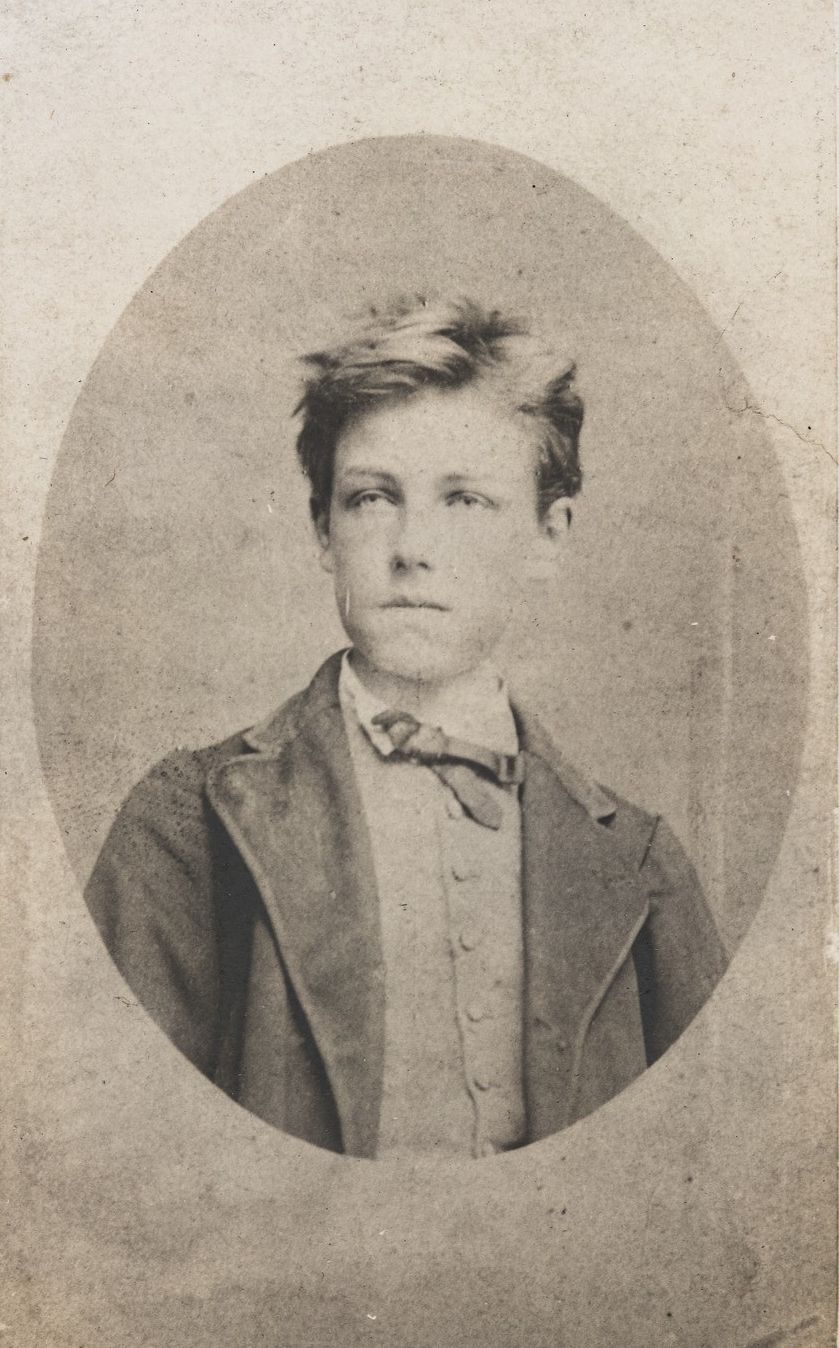
Arthur Rimbaud, an emblematic figure of French poetry and also my favorite French poet. There are many reasons why I admire him, but the most important is his age: he started writing at just 15, and he didn’t write trash! At 15, Rimbaud wrote Le Dormeur du Val, one of the most famous and important French poems, which criticizes the Franco-Prussian war in such a subtle way that it’s truly impressive to think that it has been written by a teenager. He was indeed by no means an ordinary person; many consider him a genius. At school, he was a more-than-excellent student, at such a point that even his principal noticed him. He even said «Rien de banal ne germe en cette tête; ce sera le génie du mal ou celui du bien.» («Nothing banal grows in this mind; he will be either the genius of evil or that of good.»). As you can see from the title, the answer is a little more complex than what you might expect. Don’t let his angel face fool you!
In fact, Arthur has always been somewhat…turbulent. For example, around the age of 16, he decided to run away from his small town in Northern France to go to Paris, where the revolution of the Paris Commune had just broken out. Some say he managed to get among the revolutionaries, others say he was rejected by them, and others even say he was raped by a group of revolutionaries. What we certainly know is that he went to Paris and came back disappointed.
Back in Charleville, Arthur carried on reading and writing poems. He was particularly interested in a group of Parisian poets: the Vilains Bonshommes (the Bad Gentlemen). He wished to join them, so he decided to write a letter to two of them: Théodore de Banville, the leader, and Paul Verlaine – don’t forget this name! Arthur received a quite satisfying reply from Verlaine: «Venez, chère grande âme, on vous appelle, on vous attend!» («Come, dear great soul, you are called, you are awaited!»). Therefore, he joined them in Paris. He didn’t know it yet, but this was the beginning of his “Season in Hell. “
Arthur impressed the Vilains Bonshommes with his poem The Drunken Boat: they didn’t expect such a great talent from a 16 year-old who barely looks 14. Léon Valade, one of them, later declared, in La Volonté de [ne rien] savoir, that he met a «scary poet who is younger than 18» and who «either fascinated or terrified» all of his friends, talking about Arthur Rimbaud.
«As I was going down impassive Rivers,
The Drunken Boat, Arthur Rimbaud, 1870
I no longer felt myself guided by haulers:
Yelping redskins had taken them as targets
And had nailed them naked to colored stakes.»
His impressing talent is not the only reason why Arthur drew attention on him. During the first weeks following his arrival in Paris, he was hosted by Paul Verlaine, who lived with his step-family. However, Arthur got kicked out of the house by Paul’s wife after a few weeks. Why? Well, Arthur was not exactly the perfect guest… He was drunk most of the time, emptied his pipe in cupboards, stole or broke objects, and so on. After he got kicked from Paul’s house, he was hosted by other poets, who all ended up kicking him out too sooner or later. An illustrative example is the time when he was hosted by Théodore de Banville, who kicked Arthur for showing himself naked at the window.
Even when they didn’t live together anymore, Paul never let go of Arthur. They still used to be very close and to ricochet from one bistro to another to drink absinthe together at night. They were so close that rumors started spreading. People started thinking they were more than just friends, and they were right indeed. Just a reminder, at that time Arthur was 16, while Paul was 26 and had just had a newborn with his wife. The two poets didn’t care at all about these rumors; they rather enjoyed “playing with fire.” One night, they even broke in Odéon Theater completely drunk, arm in arm, and behaving like lovers. As you can imagine, given the society’s mentality in 1871, this was a huge scandal: a journal even mentioned them in an article that talked about the theater play the next day «The Saturnian poet Paul Verlaine was holding a charming person’s arm: Ms. Rimbaud.»
The two lovers had a complicated — not to say completely toxic! — relationship. They couldn’t stop fighting. Even though both suffered from this situation, Arthur was particularly violent towards Paul. Tired of rumors about their homosexuality and their relationship, the two poets often run away from Paris to live more freely in London or Brussels, but their travels don’t stop their arguments. After a particularly violent one that took place in London, Paul leaves Arthur, hoping to meet again with his wife, whom he had completely abandoned for Arthur, in Brussels. While waiting for his wife alone in Brussels, Paul buys a revolver and sends letter to many people, including Rimbaud and Rimbaud’s mother, where he threatens to commit suicide. Worried, Arthur joins him in Brussels, but the tensions had evidently not been solved at all. Their relationship came to its end in Brussels, after Paul shot Arthur twice with his revolver. Don’t worry! he didn’t die: he just got his wrist injured and terribly traumatized, at such a point that he will ask for a policeman’s protection. Paul was sentenced to two years in prison.
Back in his hometown, Arthur wrote A Season in Hell, which describes his stay in Paris. Some say that he sent a copy of this poem to Paul in jail with the dedication «sans rancune!» («no hard feelings!»). While Arthur quit poetry at just 19, after writing a collection of poems called Les Illuminations, to travel the world and quickly forgot his past lover, Paul spent his life keeping on admiring him.

«JE DIS QU'IL FAUT ÊTRE VOYANT, SE FAIRE VOYANT.»


 Science and Thoughts
Leave a comment